Can I Start a Phone Case Vending Machine Business From Home in USA
Launch a scalable, high-profit phone case vending machine business from home. Achieve 70%+ gross margins and rapid capit...

I'm the COO of GOBEAR. We help entrepreneurs, mall operators, 3C mobile stores, event venues, and campus retailers tap into high-margin, low-maintenance vending models.
How Much Does It Cost to Start a Phone Case Vending Machine Business in Australia is a question few first-time operators answer accurately—they anchor on the machine price while freight, GST, and working capital silently double the real entry cash required. Get that number wrong and a 2-month ROI window stretches into a 24-month grind.
This analysis benchmarks actual startup costs—standard units from $5,000 to $15,000, premium machines at $20,000+, and a 30–50% landed-cost premium on imports—against conservative and high-traffic ROI models. By mapping the cost thresholds that drive payback from as little as 1.1 months to more than 24, you can sidestep the common budget traps that sink new operators.
One phone case vending machine lands between AUD 5,000–15,000. Used or financed units can cut that to AUD 1,300–3,000. Working capital sits around AUD 550+.
The core number you need to know: a standard phone case vending machine in Australia costs between AUD 5,000 and AUD 15,000 per unit. This covers the machine itself—hardware, touchscreen, payment reader, and basic printing or dispensing capability. It does not cover shipping, GST, site fees, or stock. Those are separate line items that add real weight to your upfront cash requirement.
New operators often fixate on the machine price and forget everything else. That is a mistake. The machine is one piece of a larger puzzle. You need inventory, coins for change, payment hardware, transport, and possibly customs clearance. Treat the sticker price as the starting point, not the budget.
What drives the cost up or down:
If you are importing from overseas—China is the most common source—the landed cost jumps fast. A machine quoted at USD 6,299 can easily become AUD 9,500–10,500 after sea freight, insurance, customs duty, and GST. Sea freight for a 200+ kg unit runs USD 400–800. GST applies at 10% on the total import value (machine + freight + insurance + duty). You pay that upfront even if you claim it back later on your BAS.
So the practical budget tiers look like this:
Working capital per machine deserves its own mention. One Australian supplier pegs it at AUD 550+ per machine—roughly AUD 150 in coins for change and AUD 400 in initial phone case stock. That number scales with your pricing and case variety. If you stock 20 phone models with multiple colours each, your first inventory order will be higher. If you sell screen protectors and cables as add-ons, add another AUD 200–500.
Exact equipment prices swing widely. A basic vending unit might cost AUD 2,000–3,000. A mid-range custom printer lands around AUD 8,000–10,000. Full-featured smart machines with UV printing and cloud connectivity run AUD 10,000–15,000. Premium branded units with advanced design software and dual screens exceed AUD 20,000. The price tag reflects what the machine can do—faster printing, better print quality, support for more phone models, and more payment options.
The machine cost is only part of the spend. You also need to budget for ABN registration, a business bank account, transport and delivery, installation, and possibly a customs broker if importing. None of these are optional if you want to operate legally and get the machine earning. A realistic all-in startup number for one standard machine in a decent location sits closer to AUD 8,000–18,000 once you include freight, GST, stock, and site setup.
Expect to spend AUD $5k–$15k per standard unit and $20k–$24k+ for premium. Used machines appear around $9k. Hardware spec drives the gap.
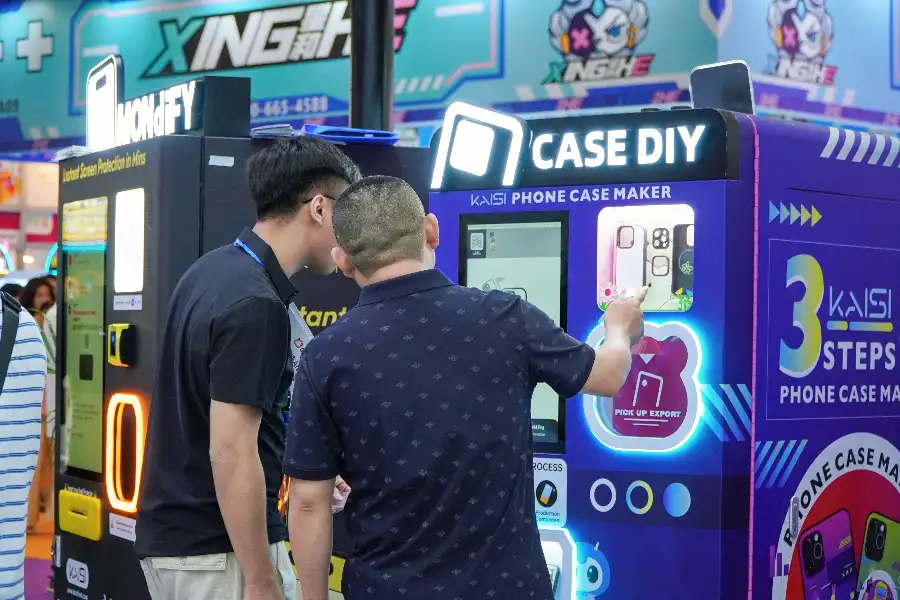
Standard phone‑case vending machines sit in the AUD $5,000–$15,000 bracket new. They custom‑print or dispense cases but scale back on screen size, print speed, design software, and payment options compared to flagship units. In Australia, used mid‑range machines list around $9,000 each (or $16,000 for two), putting the secondary market near $8k–$10k per unit.
For a multi‑location rollout, standard models cut the per‑site capital cost. That lower entry price lets an operator put machines into more centres without locking up heavy capital, trading some performance for geographic coverage.
Premium custom‑print vending machines run $20,000–$24,000+ per unit, with the $24,000 benchmark matching a fully‑featured, 24/7 self‑serve model from suppliers like Xvend. These units are pitched as high‑margin, low‑overhead assets that cost roughly one‑seventh of a comparable retail store to run, while returning profit margins around 70%.
Premium machines earn their keep in high‑traffic flagships: major shopping centres, CBD locations, airports. The higher upfront price makes sense when foot traffic and case volume can push monthly revenues above $20,000, leveraging that 1/7th retail‑cost advantage and fat per‑case margins.
The sticker price is not the landed cost. Freight, GST, and customs duties push the final figure 30–50% higher than the machine quote alone.
Shipping a 200+ kg vending machine from China to Australia by less-than-container-load (LCL) sea freight is the standard route for single-unit imports. The freight cost alone is manageable, but it's only the first layer of add-ons that inflate your total outlay.
Too many first-time buyers anchor their budget to the supplier's FOB price and get blindsided when the final invoice lands. Run your numbers assuming the all-in figure will be substantially higher.
Australian GST applies to the full import value, not just the machine purchase price. Customs duty may also apply depending on how the equipment is classified under the Harmonized System.
Get the HS code wrong, or skip the broker altogether, and you risk delays at the port plus unexpected duty assessments. Neither helps when you've already signed a site agreement and the clock is ticking on your first month's rent.
Phone‑case vending machines swap punishing shop rents for low, flexible licence fees or revenue‑share deals—typically $100–$1,000/month.
In Australian malls a vending‑machine footprint commands far lower fees than a staffed kiosk. Most operators land in the $100–$500 per month band for a standard mid‑corridor spot. Push closer to anchors, food courts or main entrances and landlords expect $300–$1,000+ per month. That might sound steep, but consider this: a high‑traffic centre can move 1,500 cases a month. At healthy per‑case margins, a $300–$500 rent barely registers.
Centres rarely tie you into a full retail lease. Instead they hand out a short‑form licence – usually 3 to 12 months – which cuts legal cost and commitment. Power and common‑area upkeep are commonly bundled into the single fee, though some sites may charge a small energy surcharge. Your main responsibility is delivery, placement, securing the machine and any branded signage.
Placement inside the centre directly determines your fee and your sales. Premium positions near supermarkets, department stores or food courts carry the highest rent but deliver the thickest foot traffic. Standard mid‑corridor spots are the workhorse: consistent flow, mid‑range cost. Secondary wings cost less but need a careful volume reality‑check. Model your expected cases per day before signing – a location that costs an extra $200 but doubles your volume is almost always the smarter bet.
Many Australian landlords, especially outside traditional retail, welcome a cut of turnover instead of fixed rent. Three structures dominate:
Let’s put numbers on it. At 1,500 cases/month and $20 per case, gross revenue hits $30,000. If you’re on a 15% pure revenue share, the location takes $4,500. Subtract $3,750 in material cost and you still net $21,750 before other overheads. Compare that to the same spot on a flat $300 rent: net would be $25,950. The revenue‑share path is costlier in absolute dollars, but it removes fixed‑cost risk and can open doors to premium centres that would otherwise demand a staffed‑kiosk rent.
This model shines when you’re testing a new site, entering a top‑tier mall without deep pockets, or placing a machine in a non‑traditional venue – universities, gyms, cinemas – where there’s no established vending‑rent benchmark. To make it work, negotiate hard on exclusivity, foot‑traffic guarantees, contract length and reporting. Landlords will want cloud‑based sales dashboards and audit rights; give them transparency and use the data to renegotiate terms once a location proves itself.
Monthly consumables and maintenance per machine range from $275 to over $1,690, shaped by sales volume and printer complexity.
Phone case vending machine consumables centre on blank cases and printing materials. For custom-print machines, a blank case plus all printing materials costs between $2 and $5 per phone case. That supports a typical selling price of $20 to $40, which yields gross margins of 70% to 85%.
Accessories like tempered glass screen protectors and charging cables boost revenue with very low unit costs—often $1 to $5 landed—and sell for $10 to $30. Their high margin keeps overall per‑transaction profitability strong.
Monthly consumables spend scales directly with foot traffic. In a moderate location generating $2,000 to $5,000 in monthly revenue, expect to spend $250 to $700 on cases, ink, and accessories. A busy flagship site turning $7,500 or more will consume $1,000 to $1,500+ per month in consumables. Other ongoing costs like receipt paper, SIM data, and cleaning materials remain negligible—usually under $30 per month combined.
Plan an annual maintenance budget of about 5–10% of the machine’s purchase price for a non‑printer vending machine, or 8–15% for a printer‑equipped unit. On a monthly basis, that works out to roughly $25 to $190 per machine, depending on complexity and age. For printer models, the largest maintenance cost items are consumable parts like print heads and UV lamps.
Service call‑outs run $150 to $300 per visit, so preventive upkeep and remote diagnostics pay off quickly. Routine inspection and minor fixes take about 0.5 to 1 hour per machine per week. If you cost that at $30 per hour, it adds $60 to $120 per month. Add in payment terminal fees and vending management software, and you’ll spend another $20 to $80 per month per machine to keep the unit connected and operational.
Real net profit spans USD 865/month in quiet suburbs to USD 14,200/month in CBD hubs. Location choice determines whether payback takes 2 months or 2 years.
| Aspect | Conservative (lower‑end) | High‑traffic (moderated) |
|---|---|---|
| Initial investment (USD) | ~9,500 | ~15,500 |
| Retail price per case | ~USD 18–20 | USD 25 |
| Profit per case | ~USD 13–16 | USD 21 |
| Cases sold / month | ~105–195 | ~600–900 |
| Revenue / month | ~USD 1,890–3,900 | ~USD 15,000–22,500 |
| Net profit / month | ~USD 865–2,700 | ~USD 8,600–14,200 |
| ROI / payback | ~3.5–11 months (can extend to 24 months in weak spots) | ~1.1–2 months; still within 2–8 months for strong Aussie placements |
This scenario reflects a single mid‑range machine in a lower‑footfall Australian location—think suburban malls, regional centres, or secondary CBD spots. The numbers assume realistic pricing and modest daily traffic. Here is what the unit economics look like:
Location sensitivity matters here. Moving from 3–4 sales a day to 6–8 cuts payback from around 11 months down to 3–4 months. Price positioning also shifts the curve—charging closer to USD 20–25 shortens ROI, while dropping to USD 15 stretches it. Fixed rent versus revenue‑share deals in smaller centres can push payback toward the 18–24 month end of the range, so negotiating a turnover‑based arrangement early on reduces downside risk.
This is the prime‑location play—Sydney CBD malls, large airports, busy university campuses. It uses a premium machine with advanced AI, a large touchscreen, and expanded inventory. The upfront cost is higher, but the unit economics flip the payback timeline dramatically.
The rent structure in prime spots shifts from a flat fee to a revenue‑share model—often 20% of gross sales. At 900 cases a month and USD 25 per case, that means handing over roughly USD 4,500 in location fees. Even with that cost baked in, the net margin stays strong enough to recover a USD 15,500 investment inside two months. A more moderated version—20 cases a day, 25% revenue share—still nets USD 8,600 a month and pays back in under two months.
Scaling from here compounds fast. Three machines in comparable locations can push annual net profit toward USD 300,000. The playbook is straightforward: secure the site, price at the upper band, and keep material costs locked near USD 4 per case to preserve the 80%+ margin that makes these numbers work.
Customs charges are the total government-imposed costs payable when importing vending machines, phone case blanks, or consumables into Australia. They typically include customs duty (a tariff based on the product's classification and country of origin), 10% GST on the imported value plus freight and insurance, import processing and clearance fees, and occasionally biosecurity or inspection fees. These charges increase the landed cost of your equipment and stock, so you should factor them into your startup budget and per‑case margin calculations. Working with a customs broker, consolidating shipments, and using free trade agreements can help manage these costs.
Yes, some local support is practically necessary even though the machine is self‑serve and unmanned. You will need someone nearby to handle installation, site negotiation, routine restocking, and occasional maintenance or repairs. If you operate the machine yourself and live close, you can cover this; otherwise, a local technician or a partner is advisable. Without local support, downtime can be longer and site issues harder to resolve, which can hurt sales and profitability.
Monthly running costs for a single phone case vending machine in Australia typically range from about A$500 to A$2,500 or more, depending on location quality and sales volume. The main expense categories are:
A machine in a high-traffic location will have higher costs but also higher revenue, while a low-traffic site keeps costs low but may limit returns.
Scaling a profitable phone case vending operation requires more than capital—it demands the financial blueprint and location economics this analysis provides. The unit metrics, landed‑cost buffers, and site‑selection frameworks outlined here are your only defense against margin erosion, hidden import fees, and under‑trafficked placements.
Don’t leave payback to guesswork. We recommend a strategic review to adapt these benchmarks to your target postcodes, product mix, and import channels. Contact our business development team to secure a detailed scaling roadmap calibrated for the Australian market.
Share your business vision with us. Our automated retail experts will craft a tailored strategy and a comprehensive profitability report to unlock your next revenue stream.