Phone Case Vending Machine VS Traditional Vending Machines: Which is Better? - GOBEAR
Phone Case Vending Machine VS Traditional Vending Machines: Which is Better? Phone case vending machines offer higher pr...

I'm the COO of GOBEAR. We help entrepreneurs, mall operators, 3C mobile stores, event venues, and campus retailers tap into high-margin, low-maintenance vending models.
The custom phone case industry is booming, driven by rising personalization trends and the global shift toward fast on-site production. But not all business models are created equal. From traditional UV printer setups to innovative CASEDIY in-store customization systems, businesses today face very different paths—each with its own investment requirements, operational structure, and long-term growth potential.
This guide breaks down the two most talked-about models: UV printing vending machines and the CASEDIY experiential customization store model. By exploring costs, evolution potential, scalability, risks, and market differentiation, this article helps entrepreneurs understand which ecosystem fits their vision, capabilities, and market positioning. Whether you're an investor, a retailer looking to expand, or a new entrant evaluating options, this comparison will give you the clarity you need to make a confident decision.
|
Category |
CASEDIY Store Model |
UV Printer Vending Machine Model |
|---|---|---|
|
Initial Equipment Cost |
High: industrial printers, display fixtures, and customer design stations |
Moderate: self-service printer vending machines with minimal setup |
|
Store Setup |
High: interior design, merchandising, and brand experience |
Low: compact machine footprint, simple installation |
|
Operational Costs |
Staffing, inventory stocking, rent, and utilities |
Minimal staffing, low utilities, predictable refills |
|
Branding Investment |
Significant: store identity, marketing campaigns, customer engagement |
Moderate: machine branding and occasional design updates |
|
ROI Timeline |
1-2 months |
6–12 months |
CASEDIY emphasizes an immersive retail experience, where customers design and create their phone cases in-store.
Requires industrial-grade printers, display fixtures, design stations, and consumer interaction setups.
Higher initial investment due to the polished retail environment and experiential design.
Long-term equipment lifecycle reduces overall depreciation cost per unit.
Staffing is needed for daily operations, customer guidance, and store management.
Inventory stocking requires a broader variety of case models, accessories, and packaging.
Rent contributes significantly, especially in high-traffic shopping areas.
Store-level branding, signage, and merchandising increase upfront cost but enhance customer retention.
Stronger visual identity creates a premium feel that justifies higher pricing.
Additional budget goes to local event marketing and community engagement.
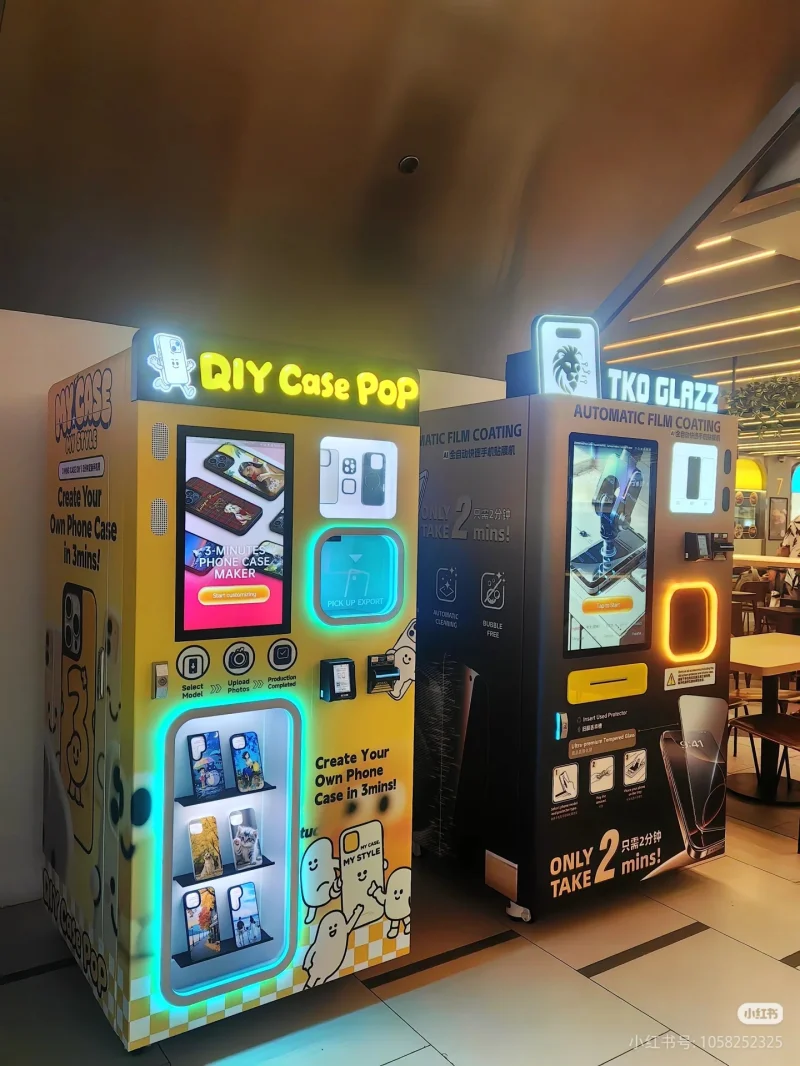
UV printing vending machines focus on automation and location-based micro-operations.
One-time machine purchase cost is relatively lower than setting up a full store.
Installation only requires a small footprint in malls, cinemas, or campus areas.
Requires periodic maintenance but with lower human intervention.
No staffing needed; operations are fully self-service.
Energy consumption remains minimal because machines operate on-demand.
Refill supply costs (cases, ink, film) are predictable and easy to manage.
Multilocation expansion is straightforward; machines can be deployed anywhere with heavy foot traffic.
Lower barrier for franchisees or small operators to enter the market.
Flexible relocation option if a site underperforms.
|
Metric |
CASEDIY Store Model |
UV Printer Vending Machine Model |
|---|---|---|
|
Revenue Stability |
Strong in premium retail locations; consistent repeat customers |
Dependent on foot traffic and seasonal spikes; moderate stability |
|
Profit Margins |
High per unit due to premium pricing |
Moderate; compensated by automation and low operating costs |
|
Payback Cycle |
Longer due to high setup and operational expenses |
Shorter due to low overhead and scalable deployment |
|
Customer Lifetime Value |
High: loyalty programs, multi-accessory upsells |
Moderate: convenience-driven repeat usage |
|
Scalability |
Moderate: requires more resources per location |
High: easy to deploy multiple machines across locations |
CASEDIY models thrive in premium retail zones where shoppers are willing to pay for design curation and quality.
Vending machines perform best in high-volume environments but may fluctuate depending on seasonal traffic.
CASEDIY offers higher margins because of the elevated brand value and diversified product lines.
Vending machines generate stable but smaller profit per transaction, compensated by higher automation.
CASEDIY stores generally have a 12–18 month payback period.
UV vending machines can reach ROI in 6–12 months due to lower operational cost.
Both models benefit from bulk production economies, but CASEDIY offers stronger lifetime customer value.
|
Dimension |
CASEDIY Evolution Pathway |
UV Printer Evolution Pathway |
|---|---|---|
|
Experience Innovation |
AR design tools, workshops, multi-device customization |
Touchscreen UX, template design, on-demand personalization |
|
Technology Upgrade |
Faster printing engines, AI-assisted pattern generation |
IoT integration, cloud-based updates, predictive maintenance |
|
Brand Expansion |
Franchising, co-branding events, community engagement |
Multi-machine deployment, seasonal and limited edition collections |
|
Market Penetration |
Lifestyle-focused, high foot-traffic stores |
Airports, campuses, entertainment hubs |
|
Timeline Highlights |
Phase 1: Traditional store → Phase 4: International franchise |
Phase 1: Basic vending → Phase 4: Full AI-assisted automation |
Future iterations may integrate AR design tools for virtual preview customization.
Potential to expand into multi-device accessories and personalized gifts.
Store concepts can evolve into creative hubs for workshops or co-branding events.
Faster printing engines, improved color reproduction, and 3D embellishment options.
AI-assisted pattern generation for instant personalized artwork.
Cloud-based design storage for customer loyalty programs.
Franchising opportunities to build global experiential chains.
Co-labs with influencers or licensed IP partners to boost consumer engagement.
Greater community influence through lifestyle-brand positioning.
Future machines may support automated case-change modules and advanced error detection.
Faster printing speeds increase output efficiency.
Integration of touchscreen UX for smoother design flow.
Cloud dashboards allow real-time monitoring of supplies and machine performance.
Predictive maintenance reduces downtime significantly.
Operators can remotely upload new design templates and marketing campaigns.
Vending machines may target niche micro-locations such as campus shops or large office buildings.
Mini-franchise mechanisms may emerge for small investors.
The model can easily integrate with social media QR-based design entry.
Phase 1: Traditional DIY store.
Phase 2: Smart experiential store with AR design.
Phase 3: Multi-category customization hub.
Phase 4: International franchising network.
Phase 1: Basic print-on-demand vending.
Phase 2: Enhanced UX with templates and cloud updates.
Phase 3: Multi-machine fleet deployment.
Phase 4: Full AI-assisted automation ecosystem.
CASEDIY evolves horizontally (more product lines + bigger brand experience).
Vending machines evolve vertically (more automation + higher efficiency).
Both paths offer strong but very different future scaling potential.
Consumers who value design experience, premium quality, and personalization.
Shopping malls, city centers, lifestyle plazas, and youth culture hubs.
Suitable for operators building a long-term physical brand presence.
Quick-service, convenience-driven users who prefer immediate results.
Airports, subway stations, universities, and entertainment complexes.
Ideal for operators prioritizing automation and low labor cost.
CASEDIY: Emotional, design-centric, experience-first.
UV vending machines: Functional, efficient, cost-focused.
Deep brand engagement through experiential interaction.
Higher customer loyalty generated by premium service context.
Ability to upsell multiple accessory categories.
Minimal operational involvement.
Highly scalable and relocatable.
Fast deployment for market testing or seasonal campaigns.
Both leverage the rising personalization trend.
Both offer fast production speeds with high-quality output.
Both models generate high-margin consumables sales.
CASEDIY stores dominate due to strong visual merchandising impact.
UV vending machines supplement traffic overflow areas.
Vending machines excel with convenience and automation.
CASEDIY less suitable due to higher rent and limited dwell times.
Both models perform extremely well depending on experiential preference.
Hybrid deployments may create synergy.
Deploy machines in clusters for brand visibility.
Use data-driven selection of locations based on foot traffic analytics.
Rotate underperforming machines to test new markets.
Co-branded designs with sports clubs, entertainment IPs, or local creators.
Integration of limited-edition collections to drive repeat usage.
Cross-promotions with café chains or shopping malls.
Cloud monitoring ensures automatic restocking warnings.
Low service costs allow operators to run multiple units simultaneously.
Seasonal themes can boost holiday revenue.
Suitable for mall operators seeking interactive retail anchors.
Enhance foot traffic and create longer dwell times in shopping centers.
CASEDIY offers comprehensive training, branding, and technical support.
Lower barrier for entrepreneurs entering the creative retail sector.
Influencer campaigns or TikTok-friendly content boosts viral exposure.
Collaborative design events strengthen community engagement.
Regular maintenance reduces UV printer downtime.
CASEDIY stores can mitigate risk by having backup printing equipment.
Focus on niche themes (anime, sports, digital artists) to differentiate.
Rotate new designs monthly to maintain freshness.
Ensure printing materials meet environmental standards.
Follow mall or venue fire/electrical regulations strictly.
Both UV printer vending machines and CASEDIY’s experiential in-store model represent exciting pathways in the booming personalization market. The vending machine model shines with its automation, scalability, and low operational cost, making it a great fit for quick expansion or passive-income operators. Meanwhile, CASEDIY’s immersive retail concept stands out with stronger brand identity, higher margins, and deeper customer engagement—ideal for businesses aiming to build long-term presence and loyalty.
As the industry continues to evolve, the winning strategy often combines technology, creativity, and a clear market positioning. Whether you're exploring a standalone vending solution or a full experiential retail environment, the opportunities are abundant—and now is the perfect time to capture this market wave.
To take the next step with reliable machinery, expert guidance, and scalable business support, visit CASEDIY Machine today:
Ready to build your custom phone case empire? Let’s make it happen.
Tell us about your business goals, and our experts will provide a tailored solution and a detailed profitability report. Let's start building your new revenue stream together.